March 2012 Archives

(1) What is a clean room

A clean room is a room supplied with particle removed air filtered by high performance filters (HEPA filter, ULPA filter). The room air pressure is kept high (positive) to prevent infiltration of airborne particle contaminants.

(2) Types of clean rooms

There are following 3 types of clean rooms classified by air flow types (see [Fig.1])

Clean room type Format Characteristic
  1. Unidirectional flow method
There are horizontal and vertical types For high quality clean rooms
  1. Non-unidirectional flow method
There are turbulence and replacement types For LCA use in medium grade clean rooms
  1. Combined method
Combination of a. and b. Easy to obtain high "Cost vs. Performance"

[Fig.1 - a] Unidirectional flow clean room type

(3) About cleanliness localization

Cleanliness localization is a concept of keeping only the required localized space clean where especially high levels of contamination control within a clean room. Following two types are the main elements of cleanliness localization, and represent a concept of realizing clean environments where necessary as opposed to making the entire room clean.

Localized cleanliness structural elements Format Characteristic
Micro
environment
  • Only the products (silicon wafers, etc.) are encapsulated and transferred to keep out contamination
  • Sealed containers are SMIF, POD, FOUR, etc.
Corresponding to high quality contamination prevention
Mini
environment
  • Contamination sensitive equipment and work areas are isolated with partition walls for contamination control
  • Systemized with sealed containers (micro environments) to create localized cleanliness
Easy to achieve co-existence of clean environments and efficient production activities.

(4) Standard clean room example

[Fig.2] shows an example of a standard clean room. Clean rooms are design to administer proper contamination control for the work to be performed. The cleanliness is made to get higher from the entrance on. The layout is designed according to the types of work (work area, equipment area, maintenance area, passage way, preparation room, etc.).

[Fig. 2] Standard clean room layout

#110 Clean Room Compatible LCA - 1

| No Comments | No TrackBacks

With the domestic industrial trends shifting towards high added values and high quality over ppm order, demands for highly functional equipment cleanliness with low investments are increasing.

(1) Technology elements required for clean compatible designs

Principles of creating and maintaining clean environments are the following 3.

  1. Do not bring in contamination.
  2. Do not generate contamination.
  3. Do not allow contamination to accumulate.

The elemental technologies to form and maintain each one of the principles on LCA mechanisms would be as follows.

[Table 1] Main technological elements comprising the 3 principles of cleanliness
3 principles of cleanliness Elemental technology Explanation
[1]
Do not bring in contamination.
Filtering technology Remove contamination with filtering
Washing /
Packaging technology
Packaging to bring in after removing contamination
Atmospheric pressure control technology Macro air flow control to maintain clean environments
Air flow control technology Micro air flow control technology to maintain clean environments
Measure and evaluation technology
(common)
Contamination amount measurement technology Air pressure /
flow measurement technology
LCA design technology (common) All LCA design technologies
[2]
Do not generate contamination.
Friction /
wear reduction technology
(Lubrication technology)
Technology to reduce particles from moving slide parts
Materials technology Corrosion resistant materials, Static electricity control materials, Sealing materials, etc.
Packaging technology Packaging
Measurement evaluation technology Same as [1]
LCA design technology (common) Same as [2]
[3]
Do not allow contamination to accumulate.
Static control technology Reduction of contamination accumulation by static charges
Air flow control technology Reduction of contamination scattering by floating
Cleaning
(Cleaning technology)
Removal of accumulated contamination
Measurement evaluation technology (Common) Same as [1]
LCA design technology (common) Same as [2]

#109 Single Axis Unit (Stage Type)

| No Comments | No TrackBacks

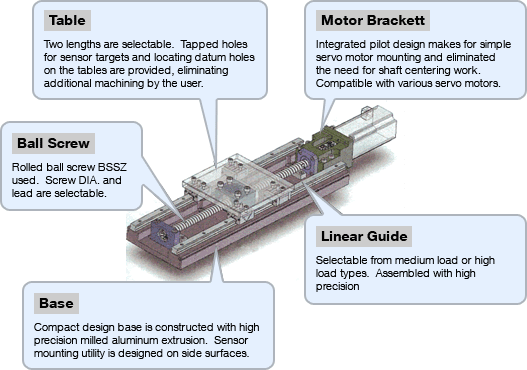
Procurement of a linear motion mechanism with a servo motor will require the following man-hour steps of a design engineer.

  1. Requires many design process man-hours due to high number of components involved.
  2. Long lead-times for precision construction elements such as linear guides and ball screws.
  3. After the parts are procured, accuracy oriented assembly work will be required.

Therefore, some challenges exist through the process of designing to completion and long lead-times. The new product "Single Axis Unit" is a proposal to assist solving these issues, and has the following characteristics.

(1) Characteristics of "Single Axis Unit"

Component procurement process and assembly work can be omitted with the following characteristics.

  1. Ball screw driven units compatible with various servo motors.
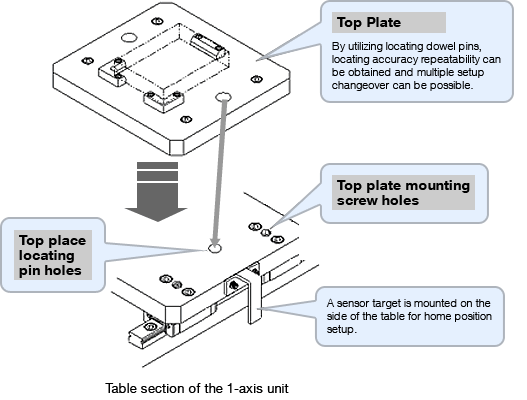
  2. Ball screw DIA., lead/base width/stroke/table length are selectable.
  3. Short delivery time, specified with only part numbers (8th day shipment).

(2) Supplementary explanation for usage

#108 Mastering Ball Screws : Characteristics of Ball Screws

| No Comments | No TrackBacks

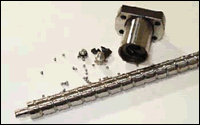
Invention of rollers contributed in dramatically reducing friction resistance when transporting un-suspended objects. Rather than dragging a stone over strewn sand, the stone can be moved with much less force if pulled over rollers. The former is an equivalent of slide linear bearing arrangement and the latter is the roller linear bearing arrangement. Ball screws are mechanical components utilizing this roller linear bearing principle to convert rotary motion into linear motion and vise versa, and have the following characteristics.

Characteristics and benefits of ball screws

(1) Very small rolling friction coefficient. (Friction coefficient = 0.002 ~ 0.004)

…Benefits

  • High energy efficiency obtained due to very small friction losses.
  • Both "rotary to linear" and "linear to rotary" motion conversions are possible.
  • Static friction coefficient and dynamic friction coefficient are very small, virtually no stick-slip occurs.
  • High rigidity and low backlash can be made possible by applying preloads.

(2) Highly reliable product backed by accumulated technologies of rolling bearings.

…Benefits

  • Running life can be approximated by calculations.
  • Quality and stability controlled by JIS Standards.
  • Performance can be maintained by normal maintenance processes such as grease applications.

Characteristics and shortcomings

(a) Precision assembled unit with point contact sliding mechanism.

  • Susceptible to shock loads. (Dents on point contact surface, etc.)
  • Somewhat inferior vibration damping characteristic (Limited by point contact design and number of bearing balls)
  • Foreign object intrusion on bearing rolling surfaces may cause unstable accuracy.
  • Bearing noises and recirculating vibrations become unavoidable as the operational speed inceases.

#107 Screws - 5 : Screw Loosening and Countermeasures

| No Comments | No TrackBacks

When two parts are fastened with a bolt, tension and compression forces are in a balance where the bolt is elongated and the fastened part material is compressed. If an external forces such as shock loads and vibrations apply to this fastening force balanced condition of the two parts, the bolt may become loose. This bolt loosening may result in equipment damages, defective product production, and critical defects that may lead to accidents. Here, typical mechanisms of screw loosening and countermeasures will be explained.

(1) Screw loosening

  • A bolt fastening two parts may become loose when the following a) and b) simultaneously occur (see [Fig.1]).
    • There are contacting surfaces 1~4 of the two parts being fastened, and external forces are applied...
    • There is a clearance between the male and female threads at nut contact 1, and a relative slippage occurs.
  • The external forces that affect the bolt loosening are: 4 types shown in [Fig.1] a)~d). These external forces cause "Reverse rotation motion" on the bolt resulting in loosening (see lower rows of [Table 1]).
    • Axial direction external force
    • External force perpendicular to axis
    • Axis rotational moment
    • Bending moment

[Fig.1] Figure of two parts fastened with a bolt and a nut

  • Other than the above, loosening not associated with "Reverse rotation motion" such as temperature variations (expansion and contraction), mechanical properties of materials, and wear (see upper rows of [Table 1]).
  • Screw loosening fundamental patterns are organized in [Table 1].
[Table 1] Screw loosening fundamental patterns
Loosening not caused by
reverse rotation motion
  1. Initial loosening
    • Loosening caused by settling of surface unevenness of the fastened parts, etc.
  2. Subsidence loosening
    • Caused by plastic deformation of seating surfaces.
  3. Wear loosening
    • Cause by minute clearances created by part wear due to vibrations and/or long operating durations.
  4. Loosening caused by settling or damages of inserted material.
  5. Loosening caused by excessive external forces.
  6. Loosening caused by heat deformation and stress relaxation.

    * Special attention is needed when fastening together parts in different materials.

Loosening caused by
reverse rotation motion
(when external forces apply)
  1. By repeated external force applied about rotation axis.
  2. By repeated external force applied at perpendicular to axis.
  3. By repeated external force applied in axial direction.

[Fig.2] Loosening model caused by force applied at perpendicular to axis.

(2) Typical bolt loosening prevention components

Typical bolt loosening countermeasures and prevention components are summarized in the following table.

[Table 2] Bolt loosening countermeasures and prevention components
Bolt loosening countermeasures Typical bolt loosening prevention components

a) Permanent deformation due to settling prevented by spring action

Spring washers

b) Reverse rotation motion prevented by increased resistance to bolt rotation slippages

Double nuts

b) Head seating surface slippage is eliminated to prevent reverse rotation motion

Adhesive

月別 Archives

Pages

Powered by Movable Type 6.0.3

About this Archive

This page is an archive of entries from March 2012 listed from newest to oldest.

February 2012 is the previous archive.

April 2012 is the next archive.

Find recent content on the main index or look in the archives to find all content.